
The Sama Framework
Designing Transformations That Last

70% of corporate transformations fail.
If you ask conventional corporate transformation experts, why, they will point to culture, change fatigue, poor communication, or a lack of leadership commitment. But after twenty years of diagnosing and fixing broken operating models, I see it differently. Those are not the root causes of failure; they are the visible symptoms of a broken operating model.
Transformations fail simply because they are designed without an understanding of the physical and structural realities of the assets or systems involved.
When we look at the broken transformations, the failure points almost always trace back to the three core issues:
The transformation is designed without a clear understanding of the actual problem.
Or, if the problem is clear, the solution isn’t systemic, it’s siloed.
Or, the fix itself quietly creates a new, hidden fragility further down the line.
I developed the Sama Framework to solve these issues. It identifies and sequences what needs fixing, formulates solutions that do not create the next fragility, and runs iteratively to surface answers outside our usual assumptions. The result is an organization that evolves continuously rather than transforms in cycles.
01 - What Does “Sama” Mean
In Sanskrit, the word Sama (सम) means equilibrium, evenness, and balance. But in Kathak - the northern Indian classical dance form I have practiced for years – Sama takes on a very specific, structural meaning. It is the first beat of a rhythmic structure (Taal). It is the home base. The point where almost all patterns begin and end.
Kathak is known for its intense, lightning-fast footwork, equilibrium-defying spins, and graceful movement all played out within strict rhythmic structures. It relies heavily on improvisation and call and response dynamic with the musicians. In this environment, Sama is where the dancer, the singer and the musicians must return together in perfect unison after creating magic on stage.
The operations of a company, an entire industry, or a material lifecycle are no different from this fine-tuned choreography. They must adapt to the rhythm of the world shifting around them. If the musicians change the tempo and you try to dance to a rhythm of the past, the math fails, and the performance falls apart.
02 - Dimensions, Diagnostics and the Plan
The framework functions by mapping a business or an industry or a Material’s lifecycle across seven distinct dimensions, organized into two layers.
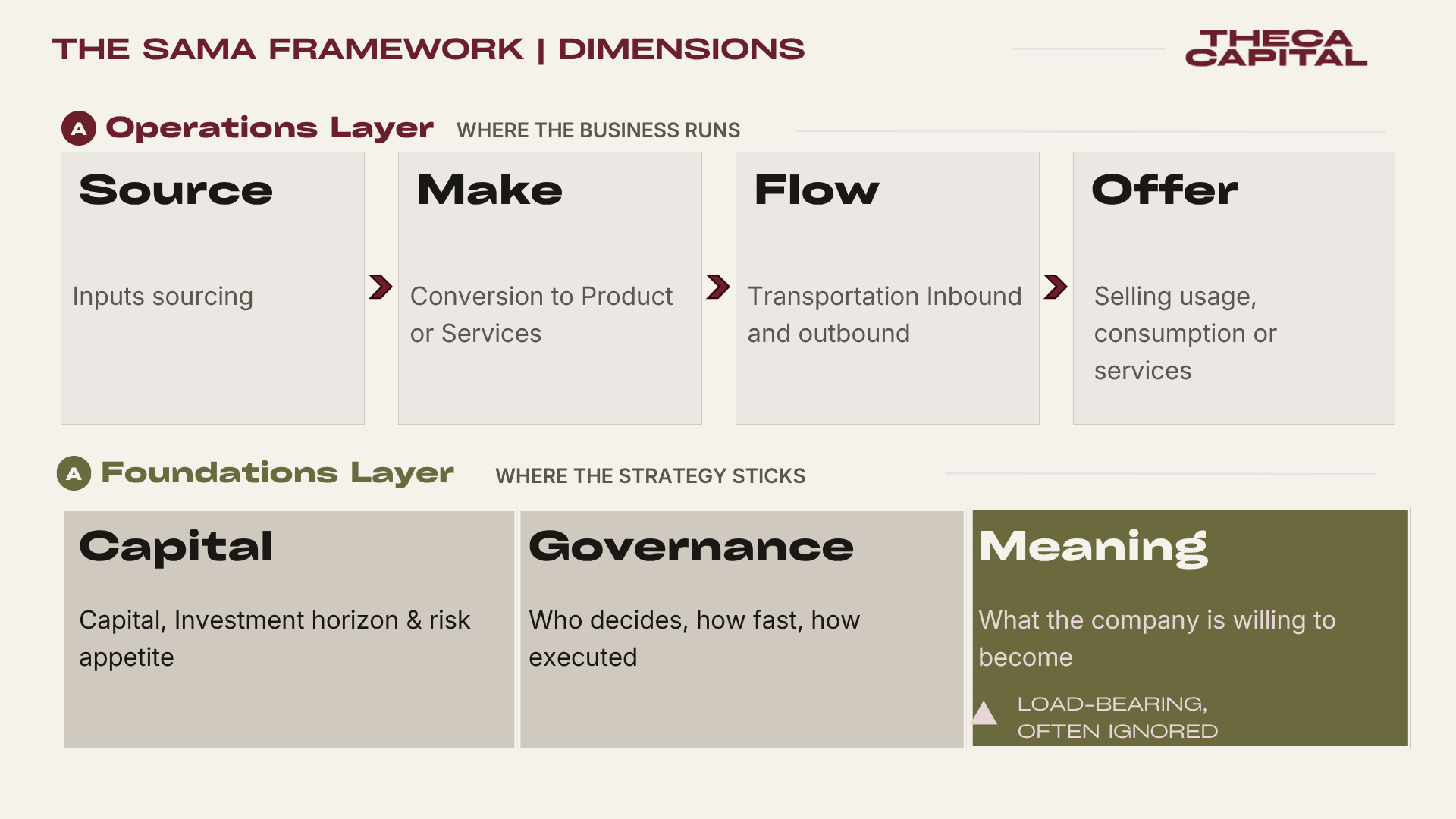
The Operations Layer (Where the Business Runs)
This is where day-to-day operations live, and it is exactly where the physical fragilities show up when the market experiences a shock.
Source. What are your primary inputs? Where do they come from, and how volatile is their supply and pricing? Are inputs renewable and in what timeframe?
Make. How and where are inputs converted to product or service? What do your production lines depend on – utilities, specialized labor, natural resources?
Flow. What does the inbound and outbound transportation network look like? What does it depend on — energy, fuel, modes of transport, geopolitical chokepoints, weather? What critical conditions exist for the product to flow to the consumer and back (if needed)?
Offer. What exactly are you selling, to whom, and how? Are you selling consumption, usage, or service? Does the offer optimize earlier steps and does it compensate for value created in other dimensions.
The Foundations Layer (Where the Strategy Sticks)
This layer determines whether a transformation takes root or falls apart.
Capital. What kind of investment is possible? What is the true time horizon and risk appetite of the money backing you?
Governance. Who makes decisions, how fast do they make them, and how are those choices communicated and executed?
Meaning. This is the company’s working definition of what it is and what it is genuinely willing to become. It is the load-bearing pillar of the foundation, yet it is the one most corporate advisors completely ignore.
The Five-step Diagnostic Methodology
To turn these dimensions into strategy, the framework runs through a disciplined, five-step diagnostic methodology designed to move an organization from initial chaos to a stabilized, predictable rhythm.
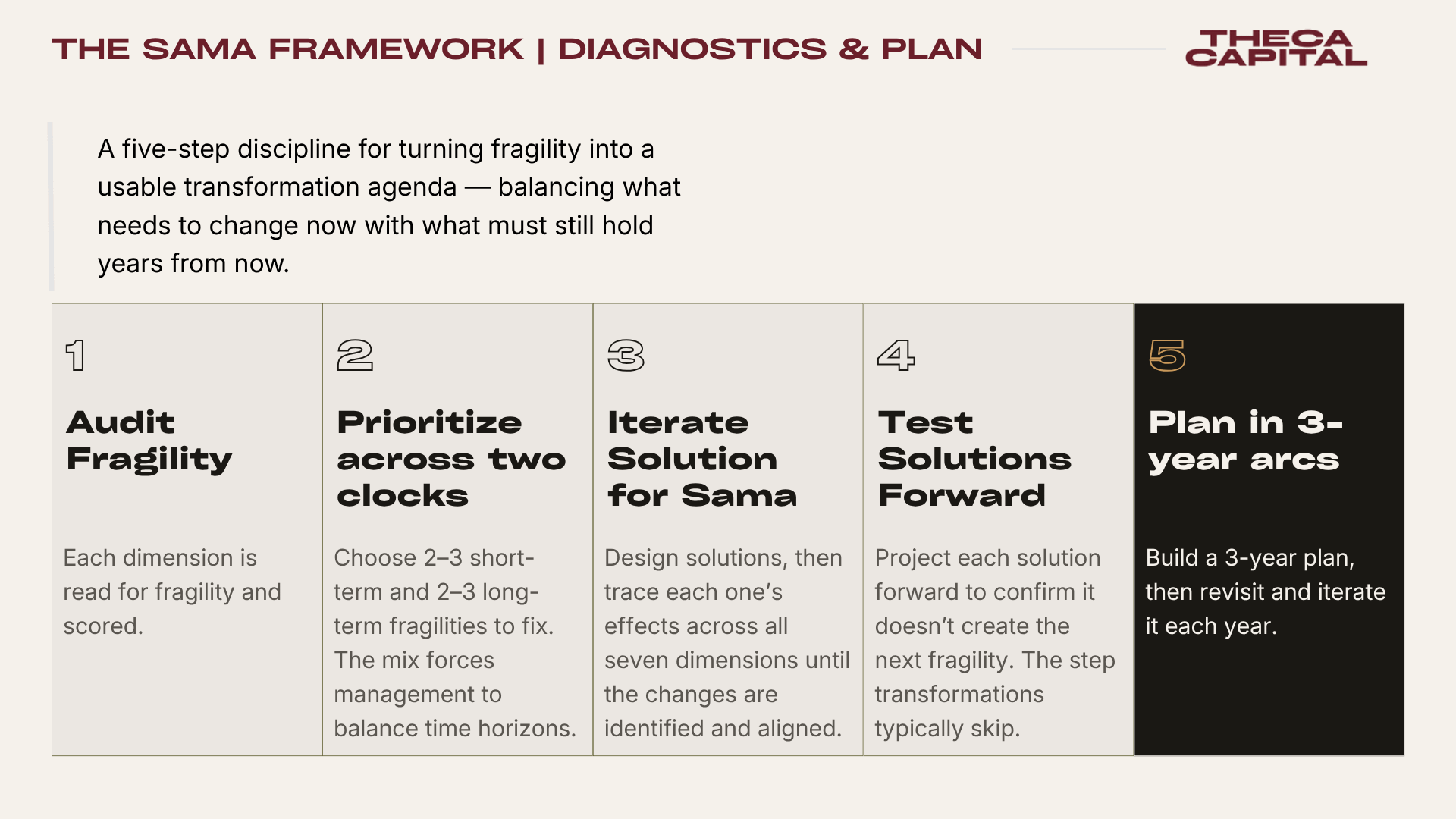
Step 1: Audit fragility
We begin by reading each of the seven dimensions for operational vulnerabilities. We don’t just look at whether something is broken today; we score it based on Trajectory, Severity, Probability, and Clock (Timing). This gives us a baseline reading of where the business is holding stable and where it is quietly building toward a cliff.
Step 2: Prioritize across two-clocks
Every operating leader is fighting immediate fires, and the framework doesn’t pretend otherwise. In this step, management is forced to choose a tight mix: two to three short-term fragilities and two to three long-term fragilities. This forces a strict balance of time horizons. The water you throw on today’s fire cannot be allowed to destroy the foundation you need to build tomorrow’s roof.
Steps 3: Iterate solutions for Sama
Once we identify the prioritized vulnerabilities, we design solutions and map their ripple effects across all seven dimensions. If a short-term patch to fix a supply bottleneck (Source) inadvertently chokes your cash flow (Capital) or compromises your product delivery (Flow), we adjust the solution and run the loop again. We repeat this process recursively until the changes required across all seven dimensions are completely identified, aligned, and in harmony (Sama).
Step 4: Test solutions forward
We project our aligned solutions into the future to confirm they do not quietly cultivate the next operational crisis down the line. We test the long-term trajectory of the solution itself. This is the step that corporate transformations typically skip, which is why so many fixes blow up two or three years later.
Step 5: Plan in 3-year arcs
The final deliverable of this five-step sequence is a highly synchronized 3-Year Plan. This is a realistic, operational roadmap grounded in physical asset realities and capital constraints. It clearly defines the exact problem being fixed and ensures that every procurement contract, product redesign, and budget move in absolute unison.
03 - What The Sama Framework does that other frameworks do not
The intellectual groundwork for this thinking was laid decades ago. The Sama Framework does not replace those foundational concepts; it synthesizes them into an executable operational discipline.
We stand on the shoulders of three distinct disciplines: McKinsey’s 7S framework for internal organizational alignment (though our dimensions are structurally different), Nassim Taleb’s work on fragility and antifragility, and the integrated diligence models that top private equity advisors have gravitated toward over the last several years.
The Sama Framework takes this mature baseline and introduces three specific, critical additions that change how a diagnostic performs:
The Trajectory axis. Conventional risk frameworks score operational vulnerabilities strictly on severity and probability. The Sama Framework adds trajectory: is today’s operating practice or market reality quietly building toward a break, holding stable, or improving? Industrial systems do not decline in a clean, straight line; they decline slowly at first, and then suddenly. Trajectory helps an operator catch tomorrow’s structural failures early enough to dance with them.
Two-clock discipline. We acknowledge that leaders must fight immediate fires, but your firefighting decisions cannot foreclose long-term moves. Each short-term action must protect, accelerate, or at a minimum, leave the door open for the long-term build.
Equilibrium iteration and Forward Testing. Running the loop to its end across all seven dimensions and then projecting the solutions forward to test their own future trajectory, is the hard work required to create real solutions instead of temporary patches. Much like a Kathak dancer who practices until the intricate math of a rhythmic pattern becomes second nature, this process becomes intuitive with discipline. A trained dancer can improvise patterns on the spot that span several cycles yet resolve perfectly on Sama.
04 - The Sama Framework in Action: The 2025 PCR Deficit
To see how this methodology functions in practice, let’s look at a major real-world breakdown.
In August 2020, the US Plastics Pact launched an ambitious roadmap. More than sixty major consumer brands signed on, committing to a four clear target. The most significant of these targets was using an average of 30% recycled or bio-based packaging content by 2025. The signatories missed the target collectively, with the aggregate landing at around 14%.
If we step back to 2020, a laundry detergent brand applying the Sama Framework would not have treated this target as a marketing checkbox. They would have run it through the diagnostic loop to see exactly if, and how, the architecture could hold.
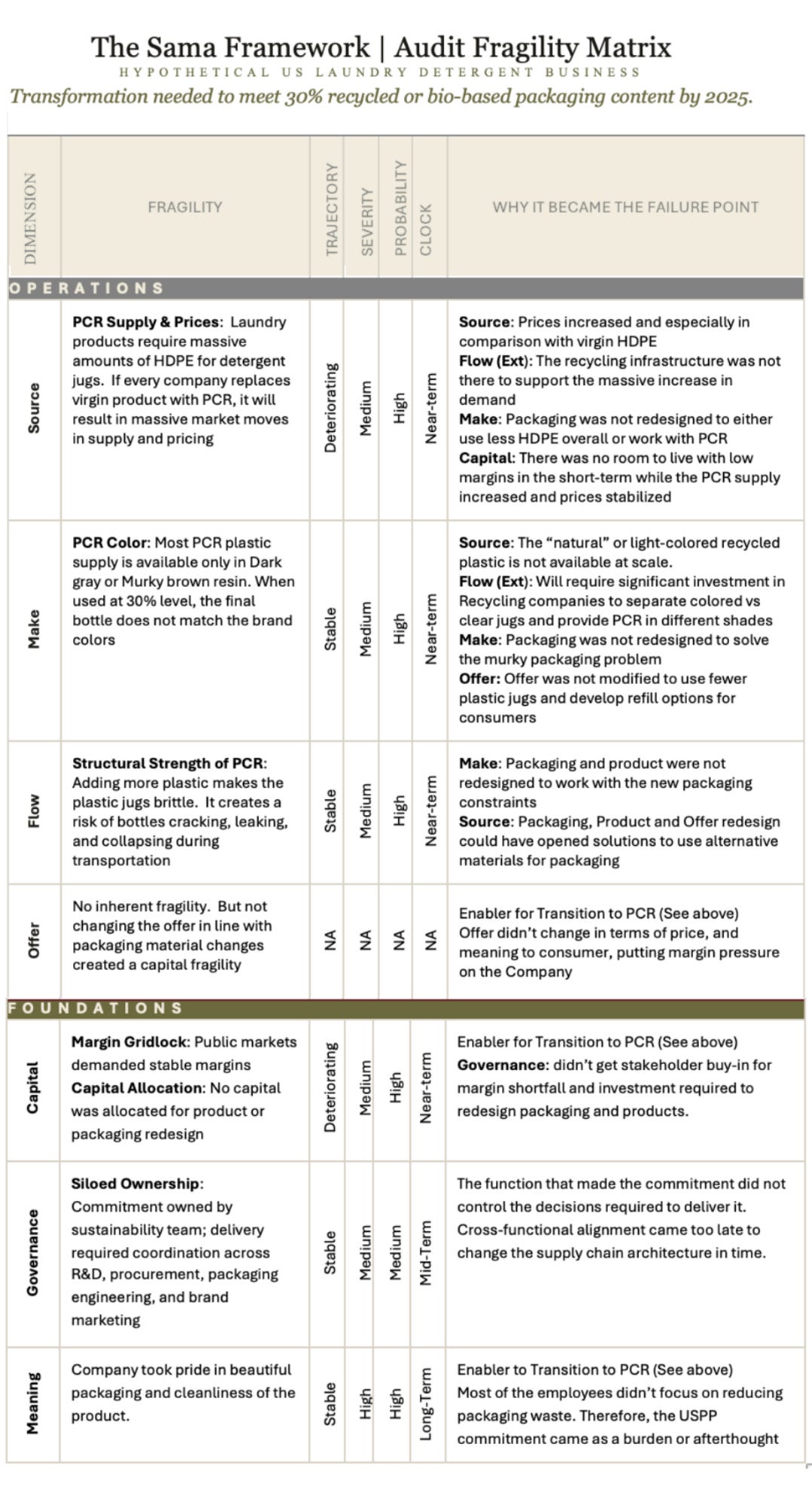
From Matrix to the 3-Year Plan
Running this data through the remaining steps of The Sama Framework’s diagnostics would have completely rewritten the company’s approach.
Instead of moving blindly into procurement, Step 2 (Prioritize across two-clocks) would have forced management to balance the immediate resin shortage with the long-term cultural and capital constraints. Step 3 (Iterate Solutions for Sama) would have shown that simply buying expensive PCR would break the brand’s margin requirements, forcing R&D to step in early to redesign the SKU format entirely. Finally, Step 4 (Test Solutions Forward) would have flagged that as competition for resin intensified, the brand needed to pivot to alternative selling formats to eliminate or significantly reduce plastic dependencies altogether but changing the offer.
The resulting 3-year plan would have set the right targets, backed by physical reality, with the correct capital structures, and investments behind them. The momentum would have held because the architecture held.
05 - Returning to Sama
Most corporate transformations fail because they are designed against an unclear problem, address the wrong fragility, or solve one problem while creating another.
The Sama Framework prevents each of these failures by diagnosing fragility across seven dimensions and sequencing fixes across two-clocks. It forces an organization to take the time to think systemically, identifying what creates true value in the short term while preserving mid-to-long-term returns.
What The Sama Framework gives an organization is the discipline to keep evolving organically. It eliminates the exhausting, capital-destructive transformation cycles that consume resources and credibility only to end up exactly where they started. When you apply this same discipline to an entire industry or a material lifecycle, it surfaces the system-level gaps that no single company can fix alone. This is exactly how the Theca Capital’s investment thesis was developed.
Finding balance amid complexity is hard work—but once you find Sama, the rhythm takes care of itself.
The Sama Framework is the foundational diagnostic methodology we use to analyze asset resilience and structural shifts. To read more about how we apply this lens to industrial footprints, visit Theca.capital.
Further Reading and Sources
US Plastics Pact and global commitments:
PCR supply dynamics:
Intellectual foundations:
McKinsey 7S Framework: Peters & Waterman, In Search of Excellence (1982)
Fragility / antifragility: Nassim Nicholas Taleb, Antifragile (2012)
Integrated PE diligence: EY, Bain, Accenture publications (2022–2026)